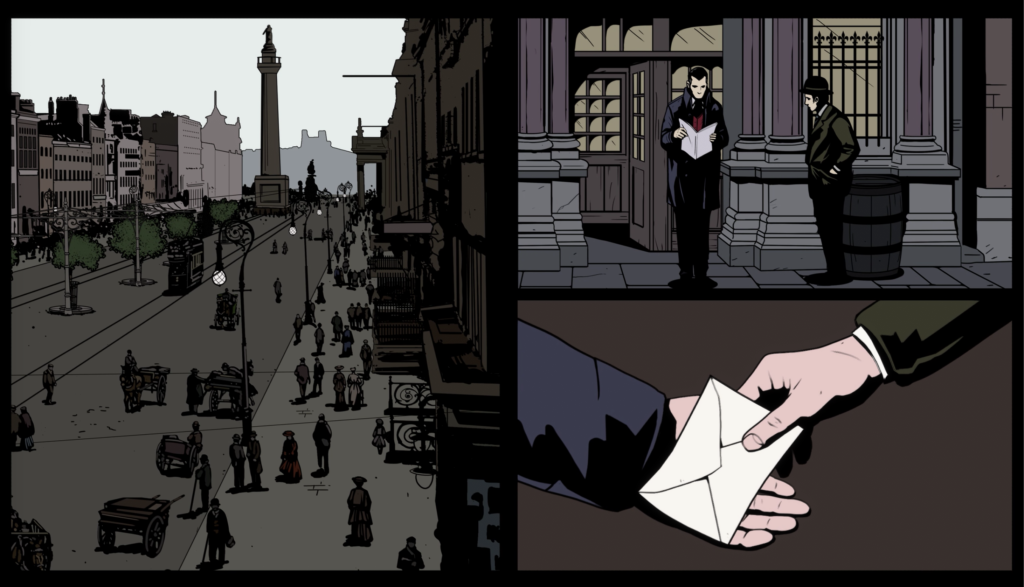
I started playing The Séance of Blake Manor (Spooky Doorway), a first person puzzle adventure and detective game. Declan Ward is hired to find Evelyn Deane, a woman who seems to have disappeared at Blake Manor. The Manor (a high-end hotel) is hosting a séance, attracting a dozen or so strange individuals who believe in the supernatural and strange. The player’s job is to explore the Manor, sneak into guest rooms, and interrogate guests and staff to find evidence of what happened to Evelyn — all of which is displayed on an elaborate mind map that allows the player to make connections to find the truth in the limited time before the seance takes place. Each investigative action costs the player a minute of time, building a sense of tension and the need to rush.
I’m only a couple of hours into the game at this point, and I’m thoroughly enjoying it. However, my set up (basically a PC emulator on my Mac) has presented some technical issues that are making it difficult to move smoothly through the game. Hopefully, I can work through it, because I’m really interested in exploring more of this story.
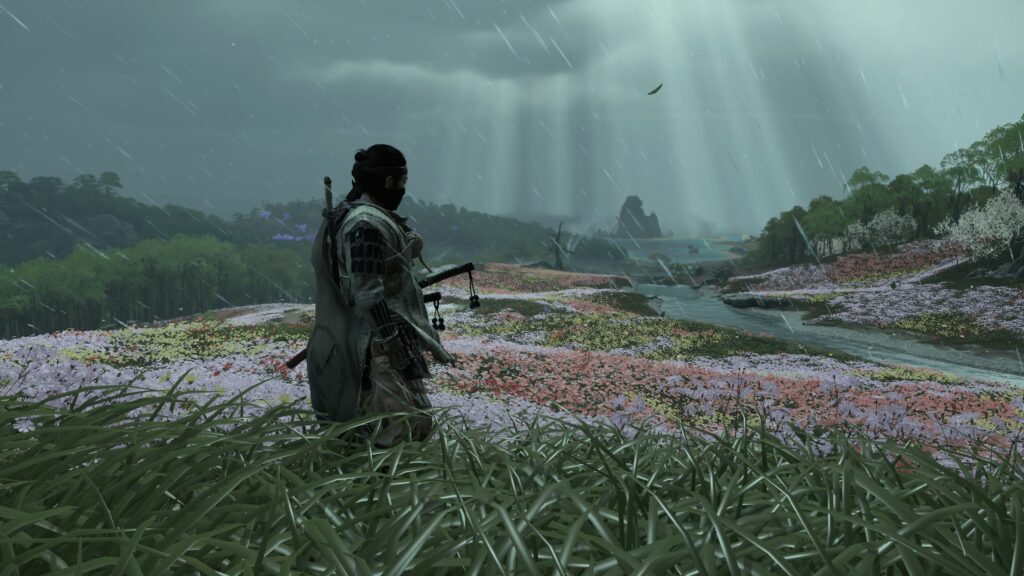
I crossed into Act II and II of Ghost of Tsushima (Sucker Punch Productions), the game took some powerful narrative turns, with Jin leaning more heavily into become the Ghost and making some choices that I felt uncomfortable with as a player. The way games can play with discomfort by having the player enact actions that might be morally conflicting is always fascinating to me. And what I love about Ghost of Tsushima is how, despite creating this sense of internal conflict (for me as the player), I still sympathized with Jin and his choices. I understood where he was coming from, as well as understanding where his uncle’s opposing perspective was coming from.
It makes for such interesting storytelling — and simultaneously changed the way I approached playing the game. In Act I and II, I tried as much as possible to stick to the samurai path, stepping directly into combat and facing my enemies head on, because I wanted to please Jin’s uncle. But in Act III, after a series of events transpired that complicated Jin’s relationship with his uncle, I found myself leaning more heavily on the ghost abilities, because it felt like I didn’t need to abide by the uncle’s old-fashioned rules. In other words, the gameplay shift this moment created in me reflects Jin’s own shift away from his uncle’s ideals.
By Act III, some of the side quests and mini games did start to feel repetitive, but I was enjoying myself so much I didn’t care. Ghost of Tsushima is one of the rare games in which I wanted to gather up everything I could, just so I could run around on my horse and fight Mongols for a bit longer.
Ultimately, the story of The Ghost of Tsushima is a heartbreaking one. Jin stays loyal to his home all the way through, but unfortunately this is not enough — and the final moments of the game pack a hearty emotional punch.
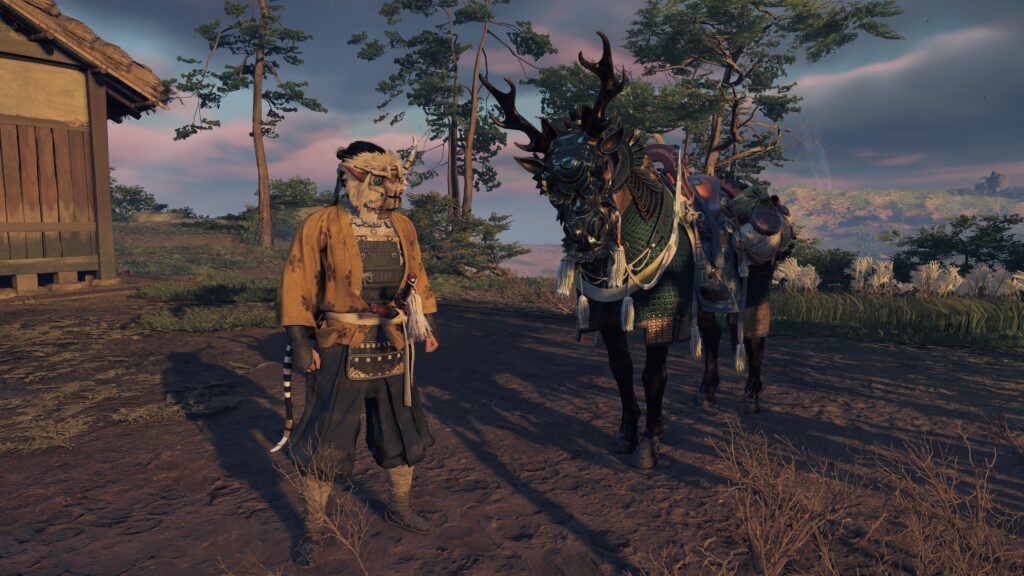
After finishing the main game, I also played the Iki Island dlc. After discovering a town of people driven mad by some strange poison, Jin returns to Iki Island, where his father had previously invaded, leaving the inhabitants with a lasting grudge against his family. But since Jin’s focus is solely on defeating the Eagle Tribe, a subset of the Mongols, and preventing them from reaching the mainland, he ends up becoming allies with former enemies.
Along the way, Jin is poisoned by the Eagle, head of the Eagle tribe. The poison causes deeply unsettling hallucinations as he explores the island and faces off against enemies, even pushing him to doubt his new allies. Each hallucination dredges up Jin’s own insecurities about his role in this war, the past actions of his families, and his honor (or lack thereof) — all meant to push him to break down his mind and will. In order to face his enemy, he had to reckon with the past, all of which makes for a very satisfying addition to the game’s overall story.

I finished up A Little to the Left (Max Inferno), a game of deceptively simple puzzles involving organizing household objects, such as cleaning up a desk space, putting junk drawer items in their proper place, and pruning plants to be symmetrical. A number of puzzles have multiple solutions, such as sorting by the size, color, and/or pattern of the object, which keeps things interesting. It’s a fun, casual time.

Steam Next Fest took place at the beginning of March, providing gamers with an immense amount of demos for games currently in development. I played Phonopolis (Amanita Design), Wax Heads (Patattie Games), Besmirch (Gangru Games), Letter Lost (FlatNine Games), Human.exe (Weird Engine), A Storied Life: Tabitha (Lab42), Our Ordinary Home (Mantaray161), and Sister Ray: A Walk on the Wild Side (The Growing Stones). A full recap of the games I played can be found at Once Upon the Weird.
I also played a cool browser game, “Wolfgirls in Love” by Kitty Horrorshow, which is a minimalist text adventure, using as few words as possible to express a sense of love, passion, and bloodshed in a queer love story about werewolves.
If you’d also like to know about the books and media that I enjoyed recently, you can check out my Culture Consumption for March.