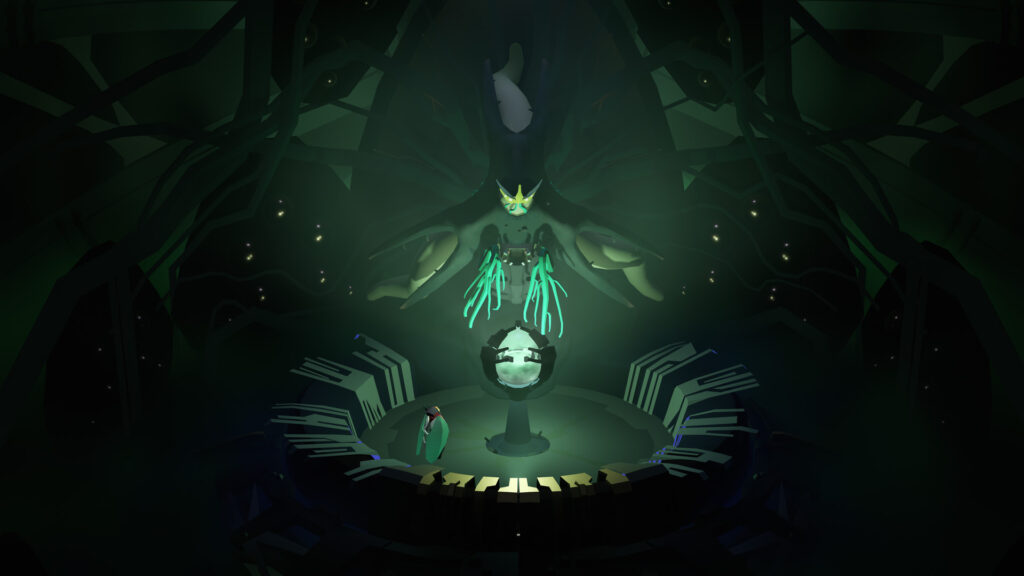
Cocoon (Geometric Interactive) is a puzzle platformer with some of the most satisfying and interesting puzzle mechanics I’ve ever seen. As a strange bug-like humanoid creature, the player is released from a cocoon and tasked with exploring and finding their way through alien worlds. The worlds are strangely biomechanical, making them feel unsettling and cohesive all at once, and the puzzles are fascinating and intuitive. In almost every instance, I could figure things out by bumbling around a bit, with the solutions being so satisfying I found myself getting emotional just through the sheer act of playing the game.
My only frustration came from the boss fights, since the gameplay felt disconnected from the beautiful wonder of the rest of the puzzles. Each boss fight just felt like an annoying obstacle holding me back from the delights of the rest of the game.

Consume Me (developed by Jenny Jiao Hsia, AP Thomson, Jie En Lee, Violet W-P, and Ken “coda” Snyder) is a coming-of-age memoir game about a young woman dealing with the daily stress of trying to be perfect and meet all your goals, when you don’t have enough time. At the heart of the stress is disordered eating and the attempt to loose weight in order to gain approval and acceptance from others.
What makes this game excellent is how much the gameplay — involving a series of mini-games — perfectly reflects the stress of each day, the feeling of not having enough time, of not completing tasks fast enough or good enough to achieve your dreams. The cute art style is also a great choice, giving it a youthful feel. Though the main character is a teenager, the style reminds me of Sanrio and similar adorable-style characters that I loved when I was a teen (alongside my love for alternative rock, horror movies, and so on). The game is fairly quick to complete was a delight.

Viewfinder (Sad Owl Studios) is a puzzle platformer that relies on the kind of fixed perspective illusions are really only possible in a digital medium. The player picks up photographs and art and holds it up to the world. When released, the images become real in the game, building new platforms or rooms or bridges, thus allowing the player to progress. As the game progresses, additional methods of forced perspective are included and the puzzles become increasingly complex.
In the narrative, the player is roaming a simulation that contains the memories and records of four scientists who had been working on solutions to climate change. The aim is to find a technology that will heal the world, in which oxygen levels have reduced forcing all of humanity inside enclosed spaces. Much of this narrative is related through communications with a collaborator outside the simulation or through audio logs and notes left behind by the researchers.
While the story is solid, the main joy is the experience of the perspective shifting puzzles themselves. It’s a beautiful, delightful, mind-bending experience.
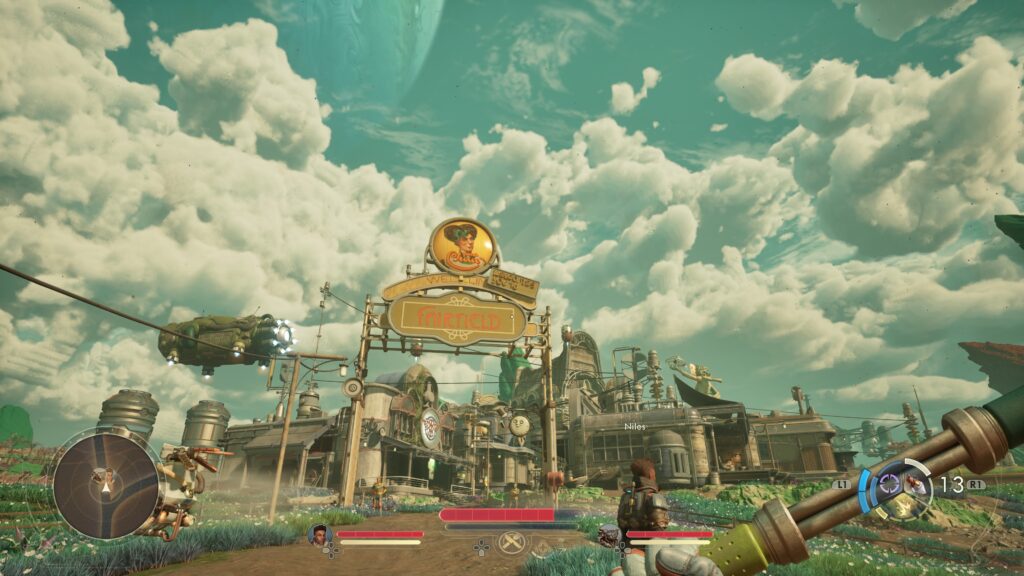
I finished up the main quest of The Outer Worlds 2 (Obsidian Entertainment). As with the first game, I found the actual ending to be the least interesting part of the narrative (compared to the many quests and side quests that led up to it). But I enjoyed the final battle and seeing everything come together. I especially liked discovering how all my choices throughout the game affected the world, the factions, and my team of companion characters.

Fallout (Interplay Entertainment) was the game that made me fall in love with the dense narratives of RPGs and apocalyptic/post-apocalyptic storytelling. The opening cinematic and the song “Maybe” by The Ink Spots is burned into my brain. I remember watching it and getting full body chills, and the way the image pulls out to reveal the wind-swept wasteland continues to haunt me.
With the Fallout TV show being so great, I decided to return to the start of the franchise. Since I only have a Mac, I have to use a bit of a janky set up playing the game through a Windows emulator. The game window is tiny and has a watermark over it, but that in no way takes away from my enjoyment of the game.
From the outset, it’s clear that Fallout is old fashioned (not really a surprise, since it came out in 1997). The game dialog is fairly direct and doesn’t quite feel as in-depth as modern RPGs. The quests are interesting and fun, but the game doesn’t provide a detailed list of the quests or reminders of the next steps to take. Hints are sparse, so the player is forced to figure it out on their own — and it’s not always immediately intuitive. So, I’ve had to look up guides on how to complete quests on more than one occasion.
Nevertheless, I’m having a great time with it. I enjoy the turn-based combat (even if it’s sometimes a bit slow). And I love returning to this world. Some of the characters and quests I remember — especially my bestie Harold. Some I’m discovering all over again. And hey, maybe I’ll actually finish the game this time.
Demos

Psychotic Bathtub, currently being developed by Natasha Sebben and her team, is a dark visual novel that explores mental health. The main character sits in their bathtub, and the player interacts with various inanimate objects to initiate conversations with them, dredging up the character’s memories or emotional state. I love the illustrated art style, the sound design, and overall tone. When released in 2026, the final game is expected to provide additional interactions and endings.

Am I Nima? is a psychological horror game in development by Ho! Games. You play as Nima, who wakes with no memory and is trapped by her mother in the basement. Through dialog options and by making mental connections (by combining words to open new memory options), the player has to figure out what’s happening and prevent Nima’s mother from doing something terrible. The game is quite creepy and I’m looking forward to exploring it further (though no release date has been announced yet).
If you’d also like to know about the books and media that I enjoyed recently, you can check out my Culture Consumption for December.